

Is it possible to stop bullying in our schools?
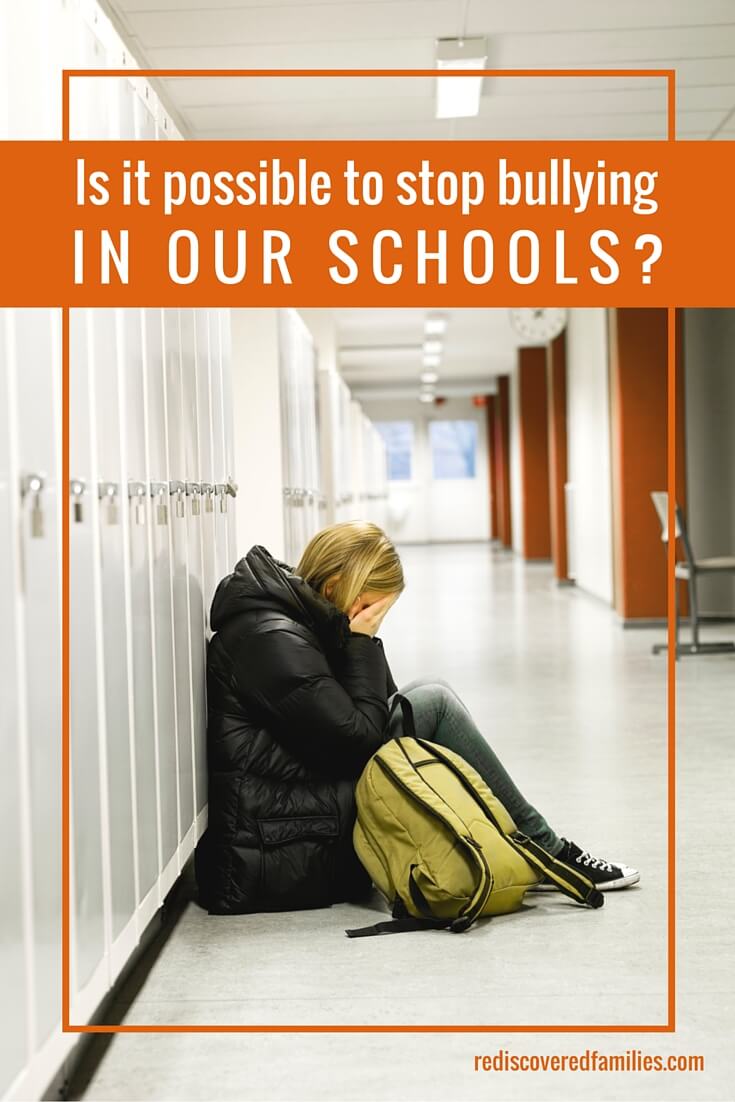 ” The girl was tormented relentlessly by her classmates. Verbally and mentally abused for months, she was humiliated and traumatized, some mornings pleading with her parents not to have to go to school for another round of abuse. In some of the darkest moments, her self worth had been eroded to such a point she thought she didn’t deserve to live at all.”
These harrowing words come from a young women who was relentlessly bullied for years. You can read her story here.
Bullying in our schools is a serious issue that seems to be rearing its ugly head more and more these days. The stories are horrible and my heart goes out to the victims and their parents. I cannot imagine anything worse than sending your child off to school knowing that it is not a safe place for them.
Is it really a problem?
In 2013 The United Nations Children’s Fund (UNICEF) published a report comparing children’s well being in developed countries.
When it came to bullying Canada came in 21st of 29 nations. We are in the bottom 10!
the same report states that only 58 % of Canadian children interviewed experienced their classmates as kind and helpful. That means that 42 out of every 100 Canadian children go to school expecting their classmates to be mean and unhelpful. How mortifying for a country whose citizens have a reputation for being nice.
If you want to see more statistics for Canada you can find them on the Canadian Red Cross website and the Government of Canada Public Safety site.
The impact of Bullying
Perhaps the best way to understand the impact of bullying is to read some of the personal stories that have been published on the Internet.
“It was mental torture everyday, I couldn’t sleep every night worrying about going into school the next day, I tried to pretend I was ill but my parents never fell for it, so got sent to school anyway. All the name calling, teasing, laughing at me and sniggering behind my back every single day, I felt horrible, alone and I hated myself, really hated myself.”
According to the researchers at Prevnet Canada the impact of bullying is both immediate and long-lasting.
It has an impact on victims, those who bully, and on those who witness bullying.
As if this isn’t bad enough bullying in schools can also impact family relationships.
What about our schools anti-bullying programs?
Most schools are trying their best to respond to an overwhelming number of demands with limited resources. The good news is that there is an increased awareness of the harm caused by bullying. Many of our schools have policies stating that bullying behavior is unacceptable and there are anti-bullying programs in place. In fact it is a multi-million dollar industry. Unfortunately in spite of the all the money being spent too many children are still being targeted. Too many young lives are still being damaged.
Is it possible to stop bullying in our schools?
Realistically I’m not sure it will ever be possible to eradicate it completely. Still I think that we can do a lot to address the issues.
I believe there is a problem of perception. As a society we tend to look at bullying as something that happens between individuals. It is regarded as an isolated problem between a bully (or bullies) and the victim. We need to recognize that while the actual incidents of bullying occur between a two or more players it is our culture that permits it to occur.
I really appreciate this quote from Barbara Coloroso in her book The Bully, the Bullied, and the Bystander.
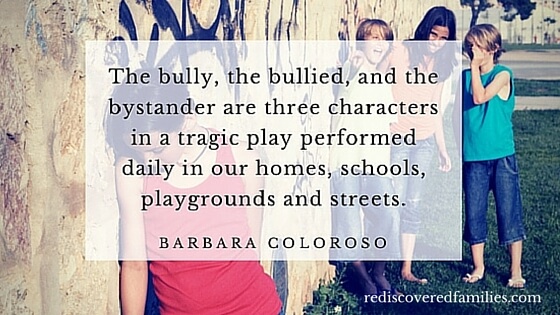
If we are to have any hope of addressing the issue of bullying in our schools we have to look at changing the culture in our school AND in our whole community.
I understand that most parents want a quick fix. Your child is being bullied in school and you want the school to do something to make the problem to go away.
I’m sure that educators, and administrators would like nothing more than to be able do that. Unfortunately it’s just not that simple. A student does not wake up one morning and decide to become a bully. It’s something that develops over time. Generally speaking bullies are made not born.
Unfortunately we cannot hope to solve this problem with a quick “one size fits all” flashy program with lots of bells and whistles. What we need are programs that focus on prevention rather than on management, because the things we have been doing so far don’t seem to be working that well do they? We need programs (and resources) to help us develop a positive culture in school, homes, and the community. We all need to work together to build the kind of environment where bullying isn’t tolerated and violent aggressive behavior is no longer supported.
That sounds great, but what if my child is being bullied now?
I would suggest you educate yourself. Knowledge is power and there are some helpful steps you can take. Then get ready to advocate on behalf of your child and every other child who is suffering. Ask about the procedures in place for reporting bullying at your school. Document every conversation. Find other parents whose children are being bullied and join together in your efforts. Recruit other community members to help advocate alongside you. Bullying has an impact on the whole community. It is not just a problem for schools, parents and students to solve.
The website Prevnet Canada has a wealth of resources.
Parents click here to access information and practical strategies to help your children build healthy relationships and prevent violence.
Educators click here to find great articles to help you deal with bullying in your classroom and school community.
There are also resources for kids and teens.
If you want to learn more about cyberbullying and what to do about it you will find some helpful information here.
Want to read more?
Read a helpful definition of bullying from the Royal Canadian Mounted Police.
Learn about the difference between bullying, aggression and teasing.
Now it’s your turn
Has your child been bullied at school? What advice would you give to a parent dealing with this issue? What do you think might reduce bullying in our schools? Has your school used an anti bullying program that has been helpful? Leave your comments below.
