

Dyscalculia: Is Your Child Struggling With Math?
Does your child struggle with math? Have you heard of the Dyscalculia? It is estimated that 4-6% of the population have this mathematical learning disability, but many children are never diagnosed. Learn the symptoms of little known learning disability. Click through to find resources and strategies to help your child at school. #dyscalculia #specialneeds #SpecialEducation
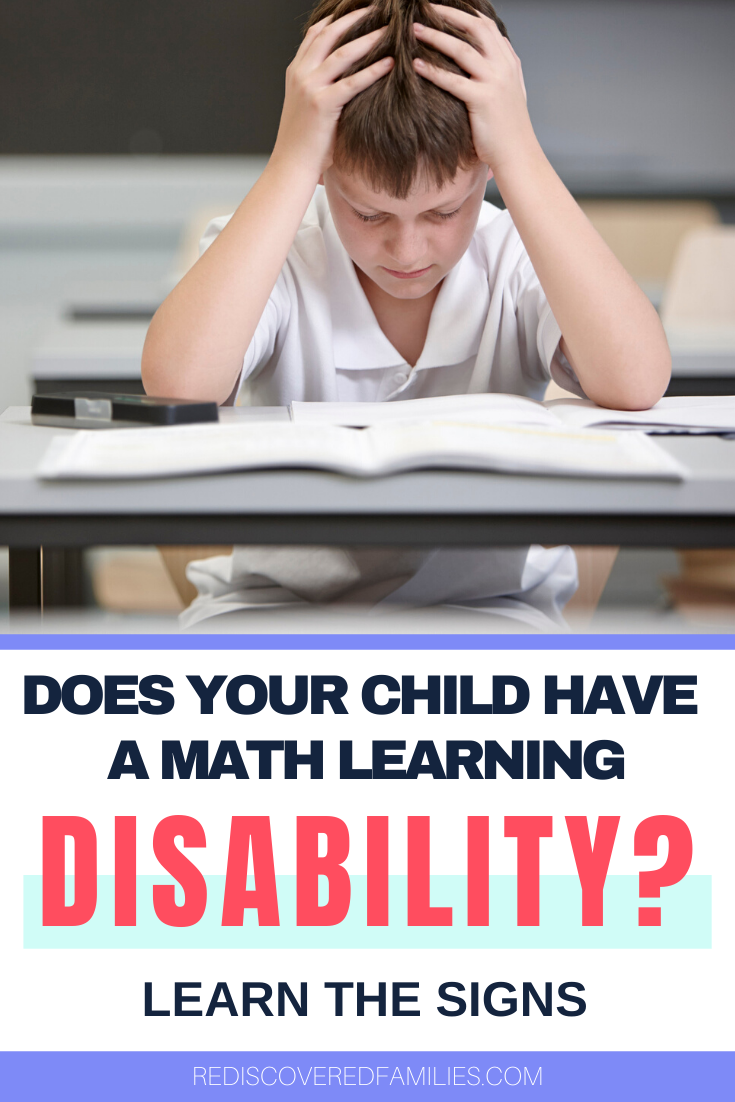
The pencil went flying across the table.
“I can’t do this,” yelled my son. “Math is stupid!”
I was equally frustrated. “Your attitude is the problem,” I snarled.
I felt wretched. Not again. We were struggling through the daily nightmare of math homework and we had hit a wall. It happened every single time.
My youngest son was a delight. He was energetic, bright, funny, and good with people; gifted in language and read at a very early age. He was obviously very intelligent, but there is one area in which he struggled.
MATH was a nightmare
Oh how hard it was for him. Right from an early age he battled to understand numbers. He couldn’t recognize mathematical patterns or learn his tables.
Numbers and mathematical concepts were like moonbeams that slipped through his fingers. He simply couldn’t grasp them. Even the most basic math was a nightmare. Often he would work for hours, only to get most of the problems wrong.
At first I didn’t worry too much. I figured that a little extra time and help from me would get him on the road to mathematical success.
I was so WRONG.
We tried everything- flashcards, math songs, workbooks, manipulating actual objects, and computer games. NOTHING worked. We were both frustrated. I was baffled.

An unexpected discovery
I suggested that we take a break.
My youngest disappeared into his room and I made my way to the computer. I needed to do something that wasn’t math.
In my e-mail was a message that would change everything.
I belonged to an e-mail group and we were talking about finances. One of the members joked that their spouse couldn’t even balance a check book.
There was a response and I opened it.
“Trouble with every day math is a classic symptom of the mathematical learning disability Dyscalculia. People with this disability usually can’t balance their check books.”
I froze. My heart was in my mouth as I stared at the screen. All I could see were the words MATHEMATICAL. LEARNING. DISABILITY. They pulsed in front of my eyes.
A sudden realization exploded in my head. Was it possible that my son had a mathematical learning disability?
Over the next few days I read everything I could find about Dyscalculia. There wasn’t a lot of information available at the time, but I did find a list of the symptoms.
- Has trouble learning number facts… check
- Struggles with directions with left or right instructions … check
- Can’t learn tables despite repeated efforts …check
- Has trouble reading clocks and judging increments of time .. check
- Has no sense of direction … check
- Finds it hard to follow a list of verbal instructions…. check
There was a whole list of symptoms and my son had EVERY SINGLE ONE of them.
Dyscalculia the little known mathematical learning disability
The word Dyscalculia comes from Greek and Latin, which means, “counting badly.” People with this disability have significant problems with numbers.
You can find a comprehensive list of symptoms here.
I had no idea!
As learned more about this mysterious learning disability I recalled the struggles of my son. I replayed every harsh word I had spoken to him when the frustration got too much. Mother guilt kicked in big time. I was a trained educator for goodness sake. How could I have missed this?
I asked the school to test my son. Less than one month later an educational psychologist diagnosed my son with Dyscalculia.
If only we had known earlier
Oh how I wish we had known earlier. There are so many strategies that can help children with Dyscalculia. They would have saved us hours of frustration. I realized how deeply my son’s struggles had affected my his self esteem.
“I thought I was stupid Mom. What a relief to find out that I’m not”
My bright, intelligent, gifted son labeled himself as stupid. I was heartbroken.
Too many teachers have never heard about this learning disability
My son’s story is not unusual. Every one of his teachers had recognized the symptoms of Dyscalculia. Yet NONE OF THEM had even heard of the disability, so they didn’t make the connection. Even his math teachers were hearing about it for the first time.
Experts estimate that 4-6% of the population have this learning disability. The word is getting out to schools. Still for now thousands of learners go through school without diagnosis.
Many of them will also come to the conclusion that they are stupid.
“As a child, I was called stupid and lazy. On the SAT I got 159 out of 800 in math. My parents had no idea that I had a learning disability.” Henry Winkler
Life after diagnosis
My son is now a young adult making his way in the world. We had four years to help him develop strategies for dealing with his disability. He managed to pass his required math exams and was able to graduate from high school with no problems.
Ironically he is working at a job that requires him to do math on a daily basis. It isn’t a problem because he is able to use a calculator. He is talking about going onto post-secondary education. This disability has caused some hard struggles at time, but it hasn’t held him back one bit.
If your child struggles with math
If you have a smart child who always struggles with math I would urge you learn more about Dyscalculia. A diagnosis could make a huge difference in their lives. It will also save you hours of heartbreak and frustration. Here are some helpful resources
- DysTalk has a lot of helpful information and resources .
- The website ADDitude has some helpful information. It includes pages that list the symptoms by age.
- This year Discover Magazine printed an interesting article How Can a Smart Kid Be So Bad at Math? It gives an overview of Dyscalculia and describes some of the recent research.
- Math Geek Mama has a wonderful resource page. She also has post which features an interview with me.
My son’s diagnosis made a huge difference to him. I want to spread the word about this learning disability. I want other children with Dyscalculia get the help they need.
You can help me raise awareness by sharing this post with others. You can use the social media buttons below. Thank you.